
The third in my Phallic London series of drawings.
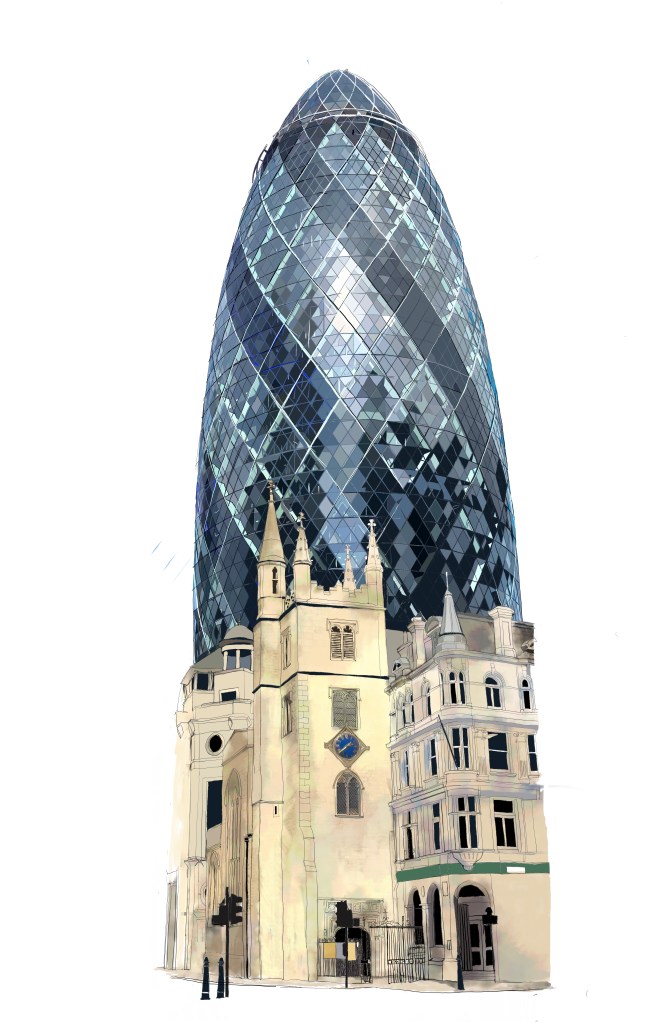
Initially, obviously and mostly the subject of this picture was intended to be the building known as The Gherkin. As far as I can tell, the building doesn’t officially have a name, or wasn’t given one by either the architects who designed it or by the people who commissioned it. 30 St Mary Axe. Yes Axe. It was nicknamed by who knows who and it stuck. Everyone calls it The Gherkin, everyone recognises it, it is beloved.
There is a softness about it that belies it’s metal and glass structure. Surrounded by some very old buildings, somehow it works, it works with the old, it works with the new. It is so snuggled amongst the surrounding architecture that it’s impossible to get a clear view of it, a view that doesn’t include other buildings. This is my favourite angle, partly because this is how you see it shortly after exiting Leadenhall Market (I love love love Leadenhall).
The church in the foreground was built early in the 1500’s on the site of a medieval church, it was untouched by The Great Fire although close to Pudding Lane where it started.
Further to this it was positioned close to a large maypole or may-shaft, this was removed after a riotous, drunken student party also in the early 1500’s. Besides encouraging outrageous spring drinking, this maypole was a pagan fertility symbol and considered inappropriate by the more strictly Christian element in the parish. It was removed. I give you this historical context to make sure you know that I know what’s what.
This maypole had given the church part of its name, a part that the church retained after the object itself was long gone.
Again I’m telling this so you can google if you think I’m making up rude stuff to fit with my theme of knobtastic London.
St Andrew Undershaft.
This is a drawing of the church St Andrew Undershaft.
That’s it’s name.
Knobtastic London no 3.
 fat tart